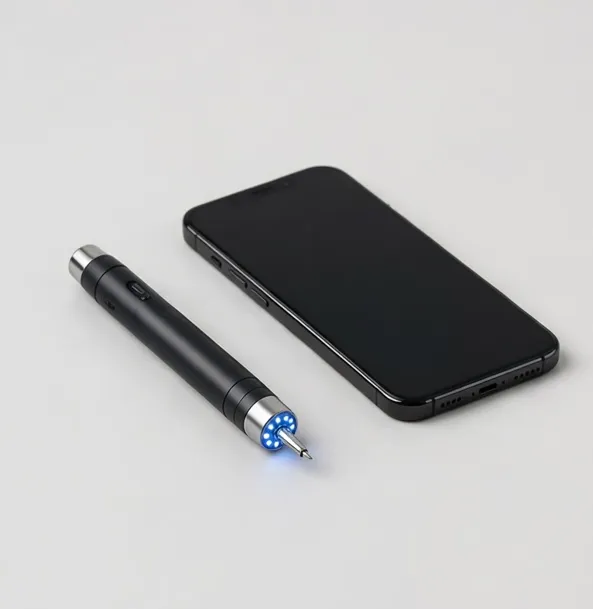
The take-anywhere microscope: live view on your phone, USB at the desk
MicroHub PocketScope WiFi Handheld Digital Microscope
None built in — phone50x–1000xWorking distance to 2.5 in
$39.99
Sample catalog — order confirmed by email
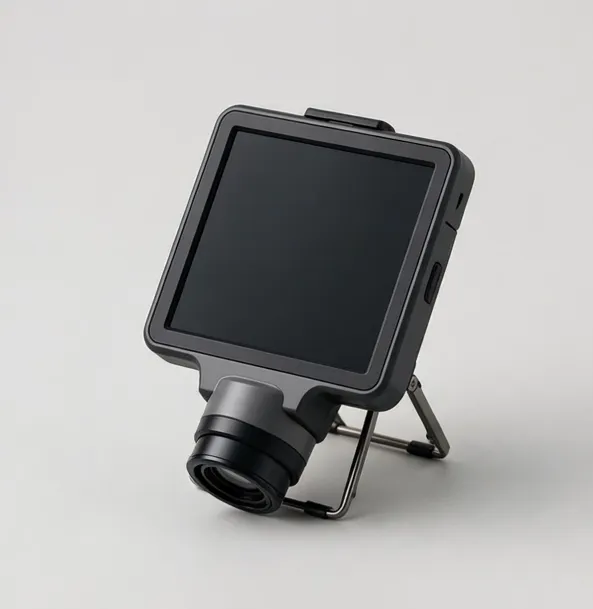
A portable microscope trades the bench for the moment: the coin at a market stall, the leaf on a walk, the board inside a customer's machine, the mineral at a show. The two designs in this category solve portability differently. Wi-Fi models stream to the phone already in your pocket, keeping the instrument tiny and cheap. Self-contained LCD models carry their own screen and battery, work with gloves on, and hand over happily to a child or a customer.
Magnification claims in the pocket class need the clearest reading anywhere in microscopy. Figures like 1000x combine a modest optical lens with aggressive digital enlargement of a small sensor image. The practical result: quick identification and satisfying close-ups for sharing, not measurement-grade detail. Every MicroHub listing separates the optical lens from the digital zoom so expectations land where the instrument can meet them.
Stability is the portable user's real technique problem. At high magnification, hand shake becomes image swim. Both designs here include a small stand for desk use, and the LCD model adds a standard tripod thread. In the field, brace the lens housing lightly against the subject's surface whenever the subject allows it — the trick every experienced user learns in the first week.
Battery life runs about two hours of continuous viewing on both designs, with USB charging from any power bank. Capture goes to the phone (Wi-Fi model) or microSD (LCD model), ready to message, list or file.
For all their limits, portable microscopes do something bench instruments cannot: they are present. Collectors, teachers, field technicians and curious kids consistently use the instrument they have with them far more than the better one at home.
Technique upgrades a portable microscope more than money does. Shoot at the lowest magnification that answers the question; use the stand or brace whenever the subject allows; take several frames and keep the sharpest; and record a scale reference — a ruler edge or a coin of known diameter — in at least one frame whenever size might matter later.
For travel kits, the supporting cast is small and cheap: a power bank, a microfiber cloth, a few specimen containers, and the folding stand. With those, a pocket microscope becomes a genuine field instrument for collectors, inspectors and the incurably curious — which is precisely the role this category exists to fill.
Handhelds also make surprisingly good teaching tools for one-on-one moments: a grandparent and a child over a feather, a mentor and an apprentice over a suspect solder joint, a dealer and a customer over a mint mark. The shared phone screen invites a second person in a way an eyepiece never does. If your microscopy is social as often as it is solitary, that may outweigh every bench advantage on paper.
Gift and gateway value is real in this category and worth saying plainly: a portable microscope is the instrument most likely to be a person's first microscope, whatever their age. Its job is to create the second look — the moment a coin, a leaf or a circuit trace becomes interesting enough to investigate properly. Judged on that job, with honest expectations about detail, the pocket class is not a compromise. It is an invitation that happens to fit in a coat.
The take-anywhere microscope: live view on your phone, USB at the desk
$39.99
Sample catalog — order confirmed by email
Built-in screen, pocket size: the grab-and-go microscope for the field and the classroom
$39.99
Sample catalog — order confirmed by email
Wi-Fi = smallest, cheapest, uses your phone. Built-in LCD = independent, glove-friendly, easiest to hand to someone else.
Pocket figures are mostly digital enlargement. Judge by sensor resolution and the sample uses: identification and sharing, not measurement.
Included stands and tripod threads tame shake. At high magnification, stability is image quality.
About 2 hours per charge; both charge from USB power banks for field days.
If you start measuring, documenting for records, or working daily, a bench LCD or HDMI model is the upgrade path — keep the pocket scope for the field.
For identification, quick checks and sharing close-ups — yes, genuinely useful. For measurement, documentation records or daily bench work, a stand-mounted model is the right tool. The honest answer depends on the job, not the gadget.
It is the optical lens multiplied by digital enlargement of the captured image. Digital zoom makes the picture bigger without adding detail, which is fine for identification and viewing, not for fine measurement.
No. The microscope creates its own local Wi-Fi link to the phone app. No router or internet connection is involved.
The LCD model is a popular choice: no phone needed, simple controls, and a stand for steady viewing. Adult supervision is sensible for younger children, as with any optical instrument.
Use the included stand on any flat surface, brace the lens housing near the subject in the field, and lower the magnification — shake grows with zoom.
Still deciding? Try the Microscope Finder or compare models side by side.