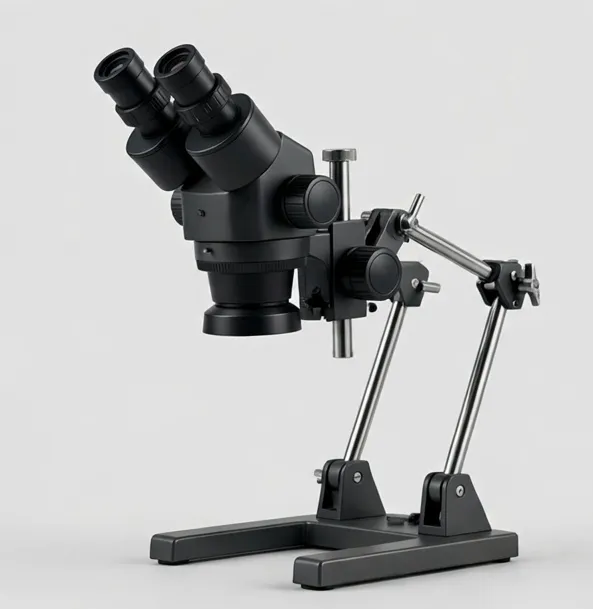
True stereo depth for inspection and repair — continuous 7x–45x zoom on a boom arm
MicroHub ZoomStereo 7x–45x Stereo Microscope on Boom Stand
7x–45x continuous optical zoomWorking distance to 4 in
$649.99
Sample catalog — order confirmed by email
A stereo microscope shows the specimen to each eye from a slightly different angle, exactly as your eyes see the world — so the image has real depth. That depth is a working tool: you can tell whether a solder joint is domed or flat, whether a gemstone sits level in its setting, whether a crack runs across a surface or through it. For hands-on work with tools, nothing digital has fully replaced it.
Magnification is lower than compound microscopes — typically a continuous zoom from about 7x to 45x with standard eyepieces, extendable down to 3.5x or up to 90x with auxiliary (Barlow) lenses. That range sounds small next to marketing numbers elsewhere, but it is honest optical magnification, and it covers nearly all repair, assembly and inspection tasks. Zoom models hold focus while you zoom, so you can start wide to orient and push in for detail without refocusing.
The stand shapes the workstation. Pillar stands suit a fixed inspection point. Boom stands — single or double arm — swing the head over large or awkward assemblies and park it completely clear of the bench, which is why electronics and jewelry benches standardize on them.
Working distance under a stereo head is around four inches: room for tweezers, a soldering iron, a screwdriver. Adding a 0.5x Barlow lens roughly doubles it, at half the magnification — a trade many technicians make happily.
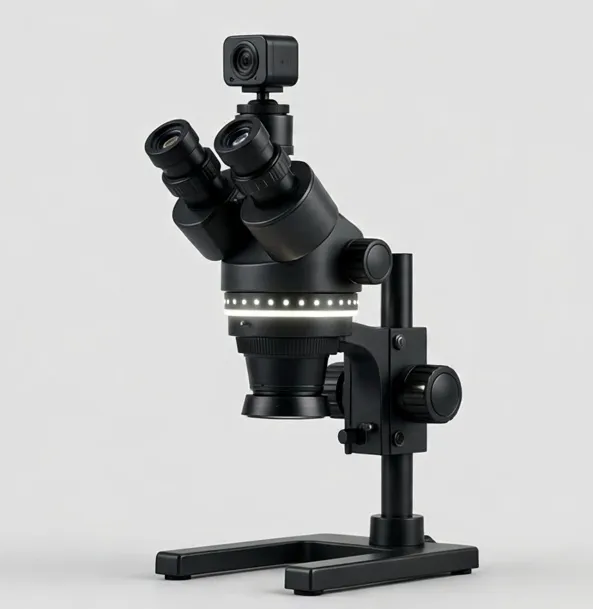
Trinocular stereo heads add a camera port to the optical view, giving you depth for your hands and a screen for a trainee, a customer or a recording. If you teach, demonstrate or document work, that combination is the complete station.
Stereo microscopes are also the dissection and specimen instrument of the biology world — the same depth and working distance that serve a watchmaker serve a student opening a flower or examining an insect whole. If your interest list mixes repair with nature specimens, a stereo head covers both without the slide-only limits of a compound model.
Care is simple and worth stating: keep the dust cover on, clean optics with a blower and tissue rather than cloth, and store Barlow lenses capped. Stereo heads are among the longest-lived instruments in any workshop — decades is normal — which is why buying the stand and head quality once is the economical path even when the sticker is higher than a screen model.
Choosing between the stereo models here comes down to two questions. Will a camera ever need to share the view — teaching, client work, records? If yes, go trinocular now; retrofitting is rarely possible. And will the head live on a boom or a pillar? Decide by bench geometry, not habit: measure the swing the work needs. Answer those two and the range narrows to one or two models, which the comparison tool then separates on price and detail.
Illumination geometry is the stereo user's craft detail: ring light for flat, even inspection; a low side light to rake across surfaces and expose scratches, cracks and engraving depth. Many benches run both, switching by task. The stereo head reveals three-dimensional truth, but the light decides which truths are visible — budget for both sources if your inspection work is surface-critical, as jewelry, watch and tool inspection all are.
True stereo depth for inspection and repair — continuous 7x–45x zoom on a boom arm
$649.99
Sample catalog — order confirmed by email
Stereo viewing plus a camera port and ring light — train others while you work
$949.99
Sample catalog — order confirmed by email
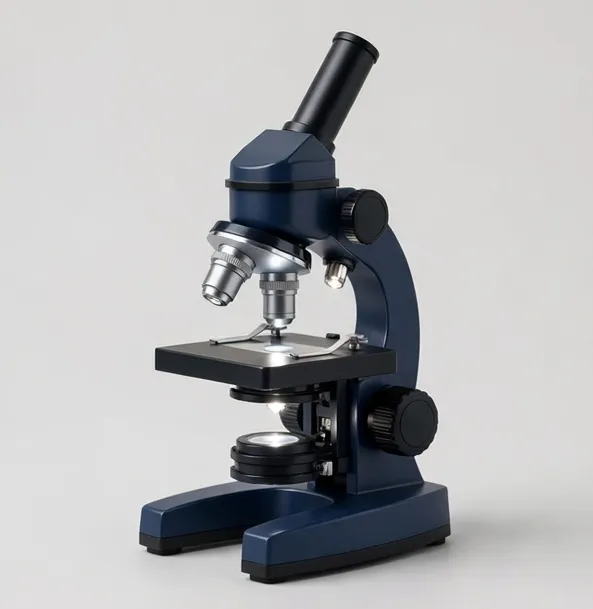
Slides and solid specimens in one student microscope, with dual lighting
$79.99
Sample catalog — order confirmed by email
Continuous zoom (7x–45x) holds focus while zooming — faster and calmer for mixed work than stepped turrets.
Pillar for a fixed station; double-arm boom for big boards, assemblies and shared benches.
0.5x doubles working distance and widens the view; 2x doubles magnification. Both thread on in seconds.
Trinocular heads let a camera share the view for training and records without giving up optical depth.
A dimmable ring light is the standard companion — even illumination with no hand shadows.
Any task where your hands work on the specimen: soldering and PCB repair, jewelry and watch work, dissection, assembly, and surface inspection of parts, coins and minerals.
Different job. Stereo trades magnification for depth perception, a wide field and long working distance. 7x–45x optical covers nearly all repair and inspection work.
Yes with a trinocular head and a microscope camera, or approximately with a phone adapter on an eyepiece. Trinocular is the clean, repeatable route.
It multiplies magnification and changes working distance: 0.5x halves magnification and roughly doubles working distance; 2x does the reverse. Technicians use 0.5x for tall parts and more tool room.
Stereo for depth-critical hand work and judging joints; digital for shared viewing, recording and posture. Many benches run a stereo head and a camera on it — the trinocular configuration.
Still deciding? Try the Microscope Finder or compare models side by side.