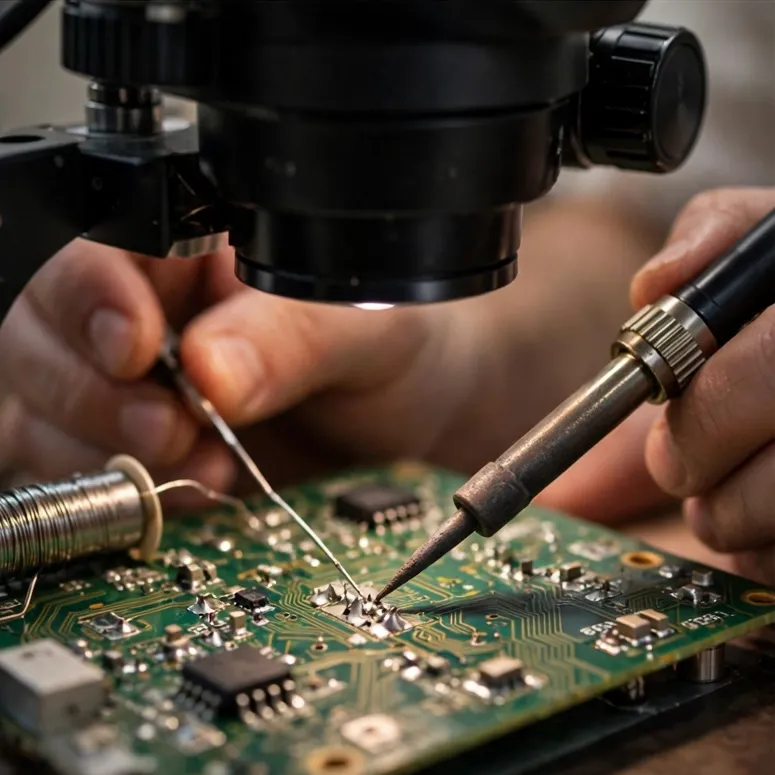
A soldering microscope is judged while your hands are moving. The specifications that decide whether it transforms your rework or gathers dust are not the ones on the box front. This guide ranks them the way bench technicians do: distance, latency, depth, stand, light — and only then magnification.
1. Working distance: the non-negotiable
Working distance is the gap between the lens and the board, and it must fit your tools: a soldering iron arriving at an angle, tweezers, solder wick, and a hot-air nozzle that needs vertical room. Below roughly three inches (75 mm), everything collides with everything. Four inches is comfortable; camera systems with long-focus lenses reach six to ten.
On stereo microscopes, distance comes from the objective; a 0.5x Barlow lens roughly doubles it while halving magnification — the classic technician trade, and usually the right one. Check the stated distance for every candidate and imagine your largest tool in the gap before you buy.
2. Latency: why the image path matters
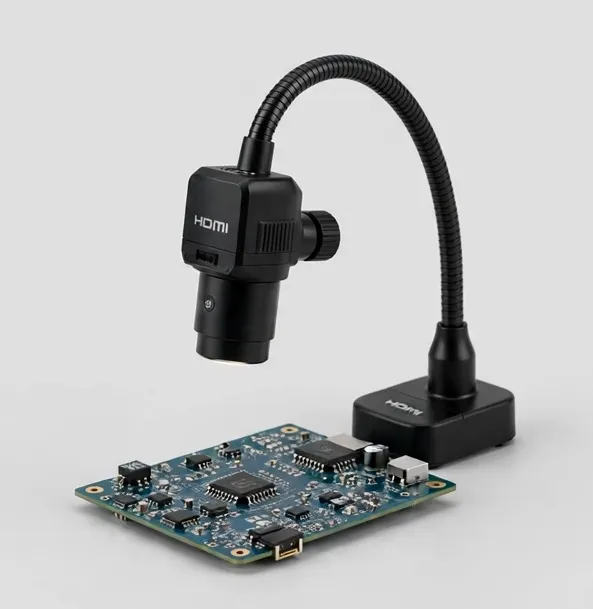
When you move the iron, the image must move in the same instant. Delays of even a fraction of a second force your hands to work behind your eyes, and fatigue and errors follow. Latency is a property of the image path: a camera feeding a monitor directly over HDMI is the lowest-lag route commonly available.
Paths through a computer (USB capture software) or a phone (Wi-Fi streaming) add processing delay. They are fine for inspection, photography and measurement — and genuinely unpleasant for continuous rework. If your bench does both, run both paths: HDMI for the work, USB for the records.
3. Stereo depth vs camera screen
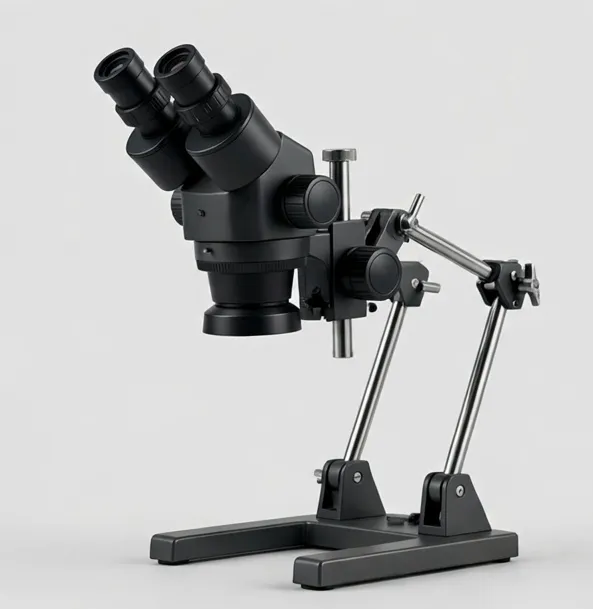
Stereo microscopes give each eye its own view, producing true depth. Judging whether a joint is domed, a pin is lifted or a component floats on its pads is depth work, and experienced technicians do it instinctively under stereo. The cost: one viewer, an eyepiece posture, and photography that needs a trinocular port.
Camera stations trade depth for everything else: a relaxed monitor posture over long sessions, a view the whole bench can share, and one-button documentation. On modern fine-pitch work both stations are legitimate; high-volume shops often standardize on camera for throughput and keep a stereo for diagnosis. The trinocular stereo with a camera is the honest compromise and the premium answer.
4. The stand is the workstation
A microscope head is only as useful as its stand. Post stands are steady for a fixed inspection point. Boom arms swing the head across a full-size board and park it entirely off the bench — the single biggest ergonomic upgrade for mixed work. Flex arms suit lightweight camera heads and frequent repositioning.
Judge stands by base weight, bearing smoothness and whether the head holds height without creep. You will adjust the stand a hundred times for every time you adjust the zoom.
5. Light and magnification, in that order
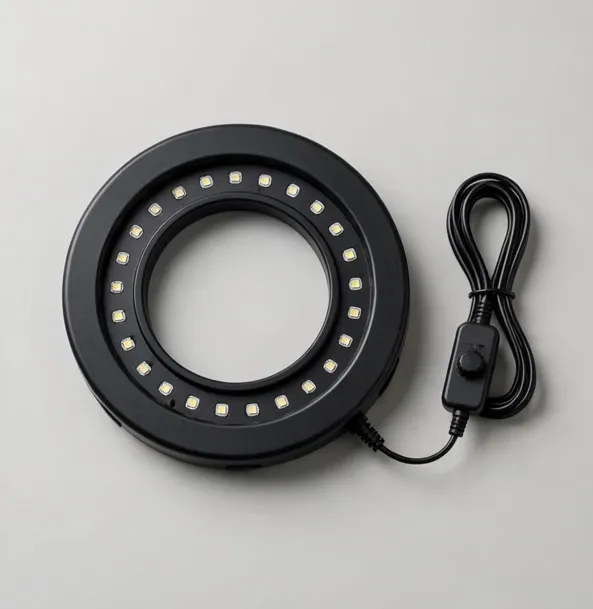
A dimmable ring light is near-mandatory: it removes the shadows your hands cast across the work, and dimming controls the glare off fresh solder. If your joints look muddy on screen, this is almost always why.
Magnification, last and least: 7x–45x optical covers through-hole, SMD down to 0402, and fine-pitch IC work. Bigger headline numbers come from screen size and digital zoom and add nothing your hands can use. Autofocus is the one modern feature worth real money on a camera station — boards change height constantly, and autofocus returns the seconds that hand-focusing steals, hundreds of times a day.
Station layouts for three benches
The phone-repair bench runs hot and fast: boards in fixtures, hot air in constant use, customers waiting. Layout: camera head on a flex arm at the bench's left, monitor dead ahead at eye level, autofocus on, capture footswitch or remote within reach for the before-and-after photos that document every board. Working distance set once for the fixture height and rarely changed.
The general electronics bench is varied: through-hole one hour, fine-pitch the next. Layout: stereo head on a double-arm boom, parked right, swung in as needed, with a 0.5x Barlow fitted permanently for distance and a ring light with a dimmer at the head. A camera on the trinocular port is the upgrade path when documentation requests arrive.
The production-inspection bench trades flexibility for repeatability: camera system on a post stand with an XY stage, fixed working distance, calibrated measurement overlay, parts flowing left to right. The microscope never moves; the parts do. Choose your layout by which of the three rhythms matches your week — the microscope models follow from the layout, not the reverse.
Mistakes when upgrading from a loupe or magnifier
The first mistake is buying magnification to match the loupe's number without the working distance: a headset magnifier works at inches from the face, and its users underestimate how much tool room a microscope must preserve. The result is a microscope that shows beautifully and solders badly. Measure your iron's approach angle before you buy.
The second mistake is judging the image in a bright showroom photograph rather than by latency and light on your own boards. The third is forgetting the bench around the microscope: extraction, ESD control, monitor height, and the iron station's position relative to your dominant hand. A microscope purchase is a bench redesign in miniature — plan it as one and it succeeds as one.
Maintaining the station
Optics in a soldering environment live hard: flux fumes film lenses, and rosin dust settles everywhere. Keep the dust cover on whenever the station is idle — it is the highest-value habit in this section — and clean the lens monthly with a blower first, tissue second, solution last. A sacrificial clear protector over the objective, where the model supports one, takes the flux spatter so the glass does not.
Cables and arms need a quarterly once-over: HDMI connectors seat fully, arm bearings hold position without creep, ring-light dimmers sweep smoothly. And recalibrate measurement after any lens, camera or stand change, logging the date — the calibration log is what makes last month's measurements and this month's comparable. Ten minutes a quarter keeps a station honest for years.
Trying before you commit
Specifications narrow the field; only your own boards finish the decision. If you can, test the finalist station on your hardest routine job — the fine-pitch IC you rework monthly, the connector you replace weekly — and judge three things in order: can your tools move, does the image keep up with your hands, and can you still see clearly at the end of an hour.
Those three answers outrank every number in this guide, including ours. A station that passes them at a modest specification will serve for years; one that fails them at a spectacular specification will be sold within one. Choose like a technician: by the work, at the bench, with the iron warm.
Reading a soldering microscope listing like a technician
Translate the listing into bench facts. "Working distance" becomes: will my iron, at its natural angle, clear the lens with the board in its fixture — yes or no, in inches. "HDMI 4K" becomes: is the live feed's latency low and the monitor mine to position — the resolution is the third question, not the first. "Magnification" becomes: does the optical range cover 10x–45x equivalents without digital zoom doing the work.
Then read what the listing does not say. No working distance stated usually means a short one. No latency language on a computer-fed system means the lag is real. No stand specification means the stand is the compromise. Technicians read absences as fluently as claims; apply the same reading here, to our listings included — they are written to survive it.
The upgrade path: loupe to station in stages
Stage one is the honest loupe or headset magnifier: fine for occasional joints, and the baseline every microscope must beat. Stage two is the working station — the microscope, arm and ring light chosen by the rules in this guide — and it is where most benches should spend their serious money, once, correctly.
Stage three is refinement: autofocus if the bench is busy, a camera on the stereo if documentation arrives, a second station if the work parallelizes. Each stage is justified by a named bottleneck the previous stage created. Buying in that order — bottleneck, then remedy — is how benches end up equipped instead of merely expensive, and it is the same discipline the rest of this site applies to collectors, classrooms and laboratories alike.
Safety and care around hot tools
A microscope concentrates attention, which quietly changes safety: your face is closer, your peripheral view is a screen or an eyepiece, and the iron is hot. Build the habits with the station: iron returns to its stand before your eyes leave the work, extraction runs whenever solder melts, and cables route where forearms do not sweep. Magnification rewards the careful and exposes the hurried — the station should be arranged so that care is the path of least resistance.
Keep the lens protected from flux spatter with a cover or protector, keep the cover on when idle, and treat any smoke film on the optics as a cleaning job for the same day, not the same quarter. The microscope will outlast several soldering stations if its glass is defended; in a hot-tool environment, defense is mostly housekeeping, and housekeeping is mostly habit.
Frequently asked questions
What magnification do I need for SMD work down to 0402?
The 10x–45x optical range covers it comfortably. Headline figures beyond that are screen size and digital zoom, not working detail.
Why do my hands feel clumsy under a USB microscope?
Latency. The computer path delays the image. Feed a monitor directly over HDMI for live soldering and keep USB for capture and measurement.
Stereo or camera for a one-person repair bench?
If documentation and posture matter (customer photos, long days), choose the camera station. If your work is depth-critical precision assembly, choose stereo. Trinocular stereo with a camera covers both at a higher price.
Is autofocus worth paying for?
On busy benches, yes. It removes a constant small interruption and keeps shared screens sharp for everyone watching. On a fixed inspection point, manual focus set once is equally good.
What is the first accessory to add?
A dimmable ring light, if your station lacks one. It removes hand shadows, which is where missed joints and bridges hide.
Products mentioned in this guide
4K HDMI camera microscope on a flex arm — autofocus keeps joints sharp while you work